The future of marketing isn’t just automated — it’s team-based AI automation.
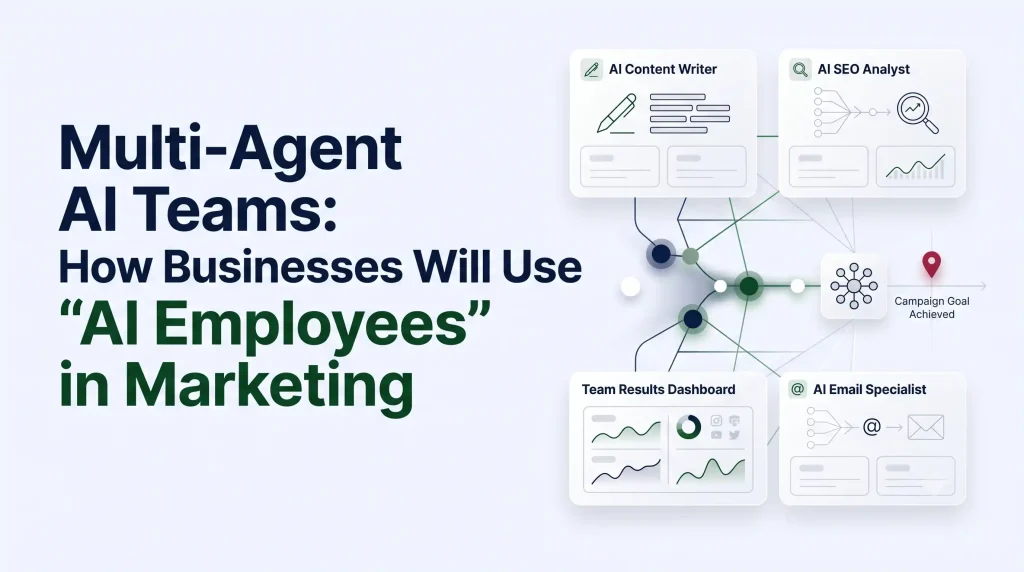
By 2026, businesses will no longer rely on single AI tools to assist marketing teams. Instead, they will deploy Multi-Agent AI Teams — networks of specialized AI “employees” working together to plan, execute, analyze, and optimize marketing campaigns autonomously.
Think of them as AI departments, not tools.
🚀 What Are Multi-Agent AI Teams?
Multi-Agent AI Teams are systems of specialized AI agents, each trained for a specific marketing function. These agents collaborate in real time, share data, and make decisions collectively — just like human teams.
Each AI agent has:
- A defined role
- A specific goal
- Access to shared data
- Continuous learning capabilities
Together, they create a self-optimizing marketing ecosystem.
🧠 Meet the AI Marketing Employees of 2026
🧑💼 1. AI Strategy Manager
- Builds campaign strategies
- Analyzes market trends
- Sets KPIs and goals
- Allocates budgets automatically
✍️ 2. AI Content Creator
- Writes blogs, ads, captions, scripts
- Adjusts tone for platforms (Instagram, LinkedIn, Google)
- Creates SEO-optimized content at scale
🎨 3. AI Creative Designer
- Generates images, banners, videos
- Tests multiple creative formats
- Personalizes visuals for user segments
📊 4. AI Media Buyer
- Handles ad bidding in real time
- Optimizes budgets dynamically
- Reduces CPA using predictive models
🔍 5. AI SEO Specialist
- Tracks ranking signals
- Optimizes content structure
- Predicts algorithm updates
- Handles AI-first & zero-click search
💬 6. AI Conversational Agent
- Manages chatbots & DMs
- Qualifies leads
- Personalizes conversations
- Books demos & sales calls
📈 7. AI Analytics & Performance Officer
- Monitors campaign data 24/7
- Predicts future performance
- Detects drop-offs early
- Suggests optimization actions
🔄 How Multi-Agent AI Teams Work Together
Here’s a real-world workflow example:
1️⃣ Strategy AI defines campaign goals
2️⃣ Content AI generates assets
3️⃣ Creative AI designs visuals
4️⃣ Media Buyer AI launches ads
5️⃣ Analytics AI tracks performance
6️⃣ Strategy AI refines approach
7️⃣ Entire system self-optimizes continuously
This cycle runs non-stop, in real time, without human intervention.
💡 Why Businesses Are Adopting AI Teams in 2026
✅ Speed at Scale
Launch campaigns in hours, not weeks.
✅ Cost Efficiency
Replace repetitive tasks, reduce operational costs.
✅ 24/7 Optimization
AI never sleeps — campaigns improve constantly.
✅ Data-Driven Decisions
No assumptions — only real-time insights.
✅ Hyper-Personalization
Every customer gets a unique experience.
📉 What Happens to Human Marketers?
AI isn’t replacing humans — it’s upgrading them.
Human roles shift toward:
- Creative direction
- Brand storytelling
- Ethical decision-making
- Strategic oversight
- Innovation & growth
Marketers become AI managers, not operators.
⚖️ Challenges & Ethical Considerations
While powerful, AI teams require:
- Strong data governance
- Transparency in decision-making
- Brand voice control
- Bias monitoring
- Privacy-first compliance
Successful businesses balance automation with accountability.
🔮 The Future: AI Marketing Departments
By 2026, brands will:
- Hire fewer people
- Deploy AI agents faster
- Scale globally with smaller teams
- Operate marketing like software systems
Marketing agencies will evolve into AI-powered growth partners.
#MultiAgentAI #AIEmployees #AIMarketing #MarketingAutomation #FutureOfMarketing #AIinBusiness #DigitalMarketing2026 #MarketingTrends #AIAgents #MarTech #MindMingleMedia